
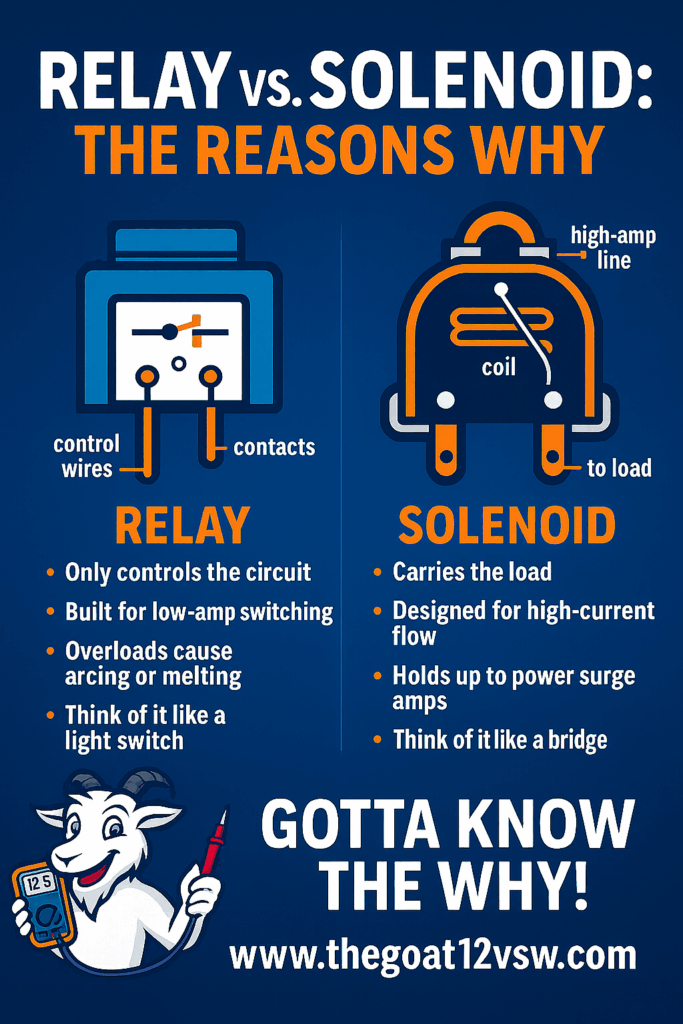
⚡ Relay (Electromagnetic Switch)
A relay is an electrically controlled switch designed mainly to control low-current or medium-current circuits.
🔹 How it works
- A small control current energizes a coil.
- That coil pulls contacts together (or apart) to switch a separate circuit on/off.
- This isolates the low-voltage trigger from the higher-current load.
🔹 Typical specs
- Coil voltage: 12 V (common for soft-wash setups).
- Load current: usually 20–40 A.
- Used for pumps, lights, or accessories.
🔹 Pros
- Compact, cheap, and easy to replace.
- Ideal for signal switching or medium-load power (pump motors, LED lights, fans, etc.).
- Often available as 4- or 5-pin automotive relays.
🔹 Cons
- Contacts can arc and pit over time.
- Not designed for repeated high surge loads like large pumps.
- Lower duty-cycle and continuous-load tolerance than a solenoid.
🔩 Solenoid (Heavy-Duty Electromagnetic Switch)
A solenoid is basically a heavy-duty relay built for high current and mechanical reliability — like a starter solenoid on an engine or your 12 V soft-wash system’s main kill switch.
🔹 How it works
- Same concept: a coil energizes a plunger.
- But instead of tiny relay contacts, it uses large copper lugs or disc contacts that can carry 100–500 A continuously.
🔹 Typical specs
- Coil voltage: 12 V or 24 V.
- Current: 100–500 A.
- Mounts with heavy posts (3/8” or 5/16”) for big cable lugs (like 4 AWG or 0 AWG wire).
🔹 Pros
- Handles massive amp loads without heating or voltage drop.
- Perfect for main battery disconnects, dual-pump setups, remote kill switches, or starter-style circuits.
- Designed for continuous duty (always energized safely).
🔹 Cons
- Larger and heavier.
- Coil draws more current.
- Slight delay on engagement (milliseconds, not a big deal).


- How to Get Leads all for free. Learn how to use the toolsHere is the video I have on youtube
- You want a 1% Voltage Drop Not 5% YUK
- New Video Over 400k View wowhttps://www.facebook.com/reel/1952248175341488 Dual 7-100 Linked back to my Facebook so you can watch it
- Had another local guy over today. Update on what we did to get him right.Another 1 fixed and tuned to the correct psi! Rewired the soft wash system from a 12 gauge on a 7 ft system total of 14 feet total! 5.3 remco 100 psi 19 amps Rewired to 6 gauge wire Changed out the Switch to a new one that can handle 275 amps on the normal.… Read more: Had another local guy over today. Update on what we did to get him right.
- A must watch on why you must use 1% drop